
Netflix’s The Crash isn’t structured like a traditional crime documentary. Instead of following events in chronological order, it builds its story around a single question: was the deadly 2022 crash an accident or an intentional act? Through interviews, digital evidence, courtroom footage, and carefully paced revelations, the documentary steadily shifts viewers from uncertainty to judgment while leaving room for debate.
Why the Documentary Feels So Compelling
After watching The Crash, what stood out to me wasn’t simply the evidence presented. It was the way the filmmakers organized that evidence.
Many true crime documentaries begin with background information before leading viewers toward a crime. The Crash does the opposite. It opens with the tragedy itself and then slowly peels back layers of information, allowing the audience to revisit the event from multiple perspectives.
That approach immediately creates tension because viewers know the outcome from the start. The mystery is not what happened. The mystery is why it happened.
A Story Built Around One Central Question
At its core, the documentary revolves around a single issue:
Was the crash a terrible accident or an intentional act?
Nearly every interview, piece of evidence, and courtroom moment feeds back into that question.
Instead of overwhelming viewers with legal details from the beginning, the film gradually introduces information that challenges initial assumptions.
The result is a documentary that constantly asks viewers to reconsider what they think they know.
The Narrative Framework
| Story Element | Purpose |
|---|---|
| Crash footage | Establishes the tragedy immediately |
| Personal history | Adds emotional context |
| Digital evidence | Builds suspicion and questions |
| Interviews | Introduces competing perspectives |
| Trial footage | Presents legal arguments |
| Verdict | Delivers the emotional climax |
Rather than presenting a straightforward timeline, the documentary behaves almost like an investigation unfolding in real time.
Act One: Establishing the Mystery
The opening section is deliberately restrained.
The filmmakers spend time introducing the victims, the circumstances surrounding the crash, and the public perception that existed immediately afterward.
At this stage, viewers are encouraged to see the event as a devastating accident.
The pacing is relatively slow, allowing the emotional weight of the tragedy to settle before larger questions emerge.
This approach creates sympathy before the documentary begins presenting evidence that complicates the narrative.
Act Two: Where the Documentary Gains Momentum
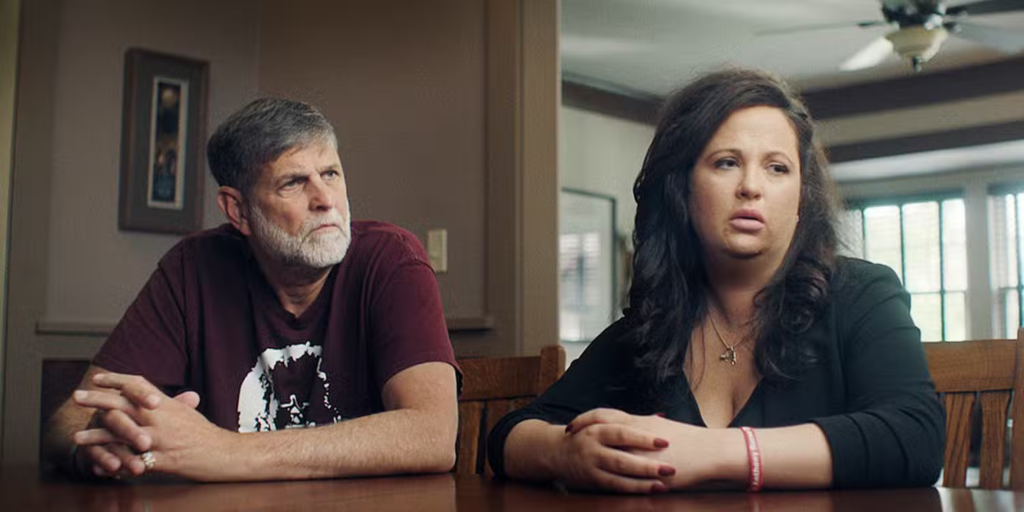
The middle portion is where The Crash becomes most effective.
This section introduces the evidence that transformed the case from a traffic fatality into a murder prosecution.
Instead of delivering information in large blocks, the filmmakers spread revelations throughout the runtime.
Key pieces of evidence are woven between:
- Family interviews
- Investigative findings
- Digital records
- Court testimony
- Personal communications
This creates a steady escalation of tension.
As viewers receive more information, the documentary gradually shifts from emotional storytelling to forensic examination.
In my view, this is where the film’s pacing works best. Each new detail feels like another piece of a larger puzzle rather than a lecture on the case.
The Importance of Multiple Perspectives
One of the documentary’s strongest storytelling choices is its use of competing viewpoints.
Throughout the film, audiences hear from:
| Perspective | Role in the Story |
|---|---|
| Prosecutors | Present the state’s theory |
| Family members | Offer personal insight and defense |
| Victims’ loved ones | Provide emotional impact |
| Investigators | Explain evidence |
| Mackenzie Shirilla | Shares her own account |
These perspectives frequently contradict one another.
That tension becomes one of the documentary’s primary storytelling engines.
Even when the film appears to lean toward a particular interpretation, it still allows viewers to hear directly from those who disagree.
A Fast-Paced Final Act
The documentary accelerates significantly once the trial begins.
By this point, viewers have already absorbed the emotional and forensic foundations of the case. The courtroom scenes function as the payoff.
The pacing becomes noticeably faster as evidence, arguments, and testimony converge toward the verdict.
This section feels less like an investigation and more like a countdown.
Every scene pushes the audience closer to the court’s final decision.
The effect is emotionally powerful because viewers have already spent much of the documentary wrestling with the same questions being addressed in court.
The Role of Digital Evidence
One of the documentary’s most modern storytelling tools is its use of digital records.
Text messages, social media activity, phone records, and electronic vehicle data are not treated as supporting material.
They become central characters in the story.
The filmmakers repeatedly return to digital evidence as a way of reconstructing events and challenging competing narratives.
This reflects how contemporary true crime storytelling has evolved. In many modern cases, technology becomes as important as eyewitness testimony.
Why the Structure Works
While some critics have argued that The Crash follows a familiar true crime formula, I think the documentary succeeds because it executes that formula effectively.
Its strengths include:
- A clear central question
- Gradual evidence reveals
- Strong interview access
- Emotional storytelling
- Consistent narrative momentum
Most importantly, the documentary never loses sight of the human tragedy at the center of the case.
Final Thoughts
What makes The Crash work is not necessarily the discovery of new information. Instead, it is the way the documentary organizes information viewers may already know.
By combining non-linear storytelling, competing perspectives, digital evidence, and courtroom drama, Netflix creates a documentary that feels both investigative and emotionally driven.
Whether viewers ultimately agree with its conclusions or not, the film’s carefully constructed pacing ensures that the central question remains compelling until the very end.
New on Netflix covers the latest Netflix releases, reviews, and streaming updates with a clear, independent voice. This publication is not affiliated with Netflix or its parent company.